
Quantum Game
Guided puzzles introducing photons, superposition, interference, polarization, and measurement.
Quantum Game →
A free, browser-based optical table for exploring quantum mechanics. Build experiments, run the simulation, and inspect quantum states and measurements.
Virtual Lab is active and independently maintained by its creators, Piotr Migdał and Klem Jankiewicz.

Virtual Lab is used in lectures, lab classes, and outreach events all over the world. If you use it in your teaching, we'd love to know where you teach, how you use it, and what would make it more useful for your students. This helps us decide what to work on next.
“All I want is the coolest quantum game in the known multiverse, please!”
Guided puzzles introducing photons, superposition, interference, polarization, and measurement.
Quantum Game →

TypeScript numerics for multipartite quantum systems in the browser.
Quantum Tensors on GitHub →
A visual editor for neutral-atom pulse sequences, developed by Quantum Flytrap for Pasqal.
Open Pulser Studio →P. Migdał, K. Jankiewicz, P. Grabarz, C. Decaroli, P. Cochin · Optical Engineering · 2022
Z. C. Seskir, P. Migdał, C. Weidner, et al. · Optical Engineering · 2022
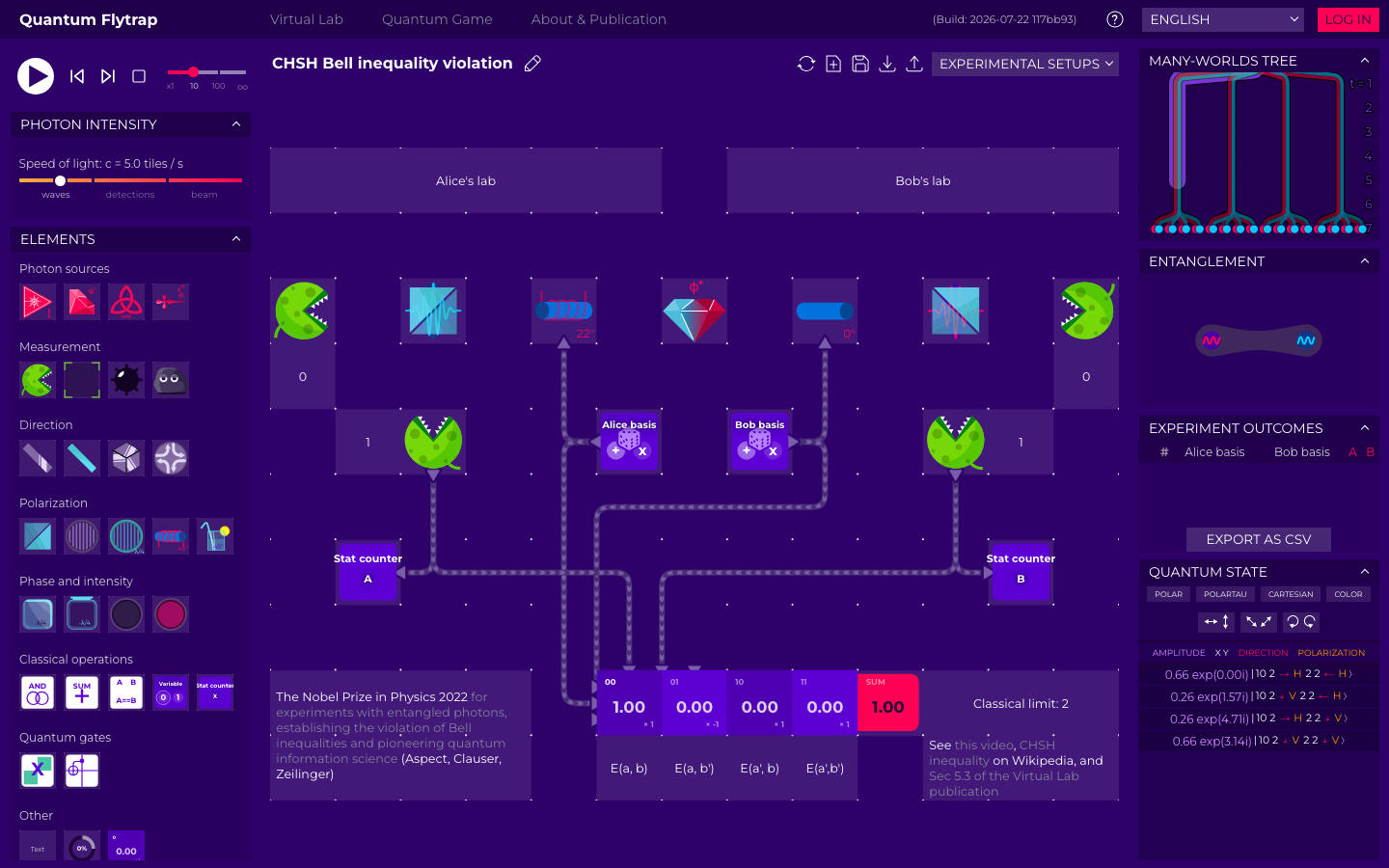
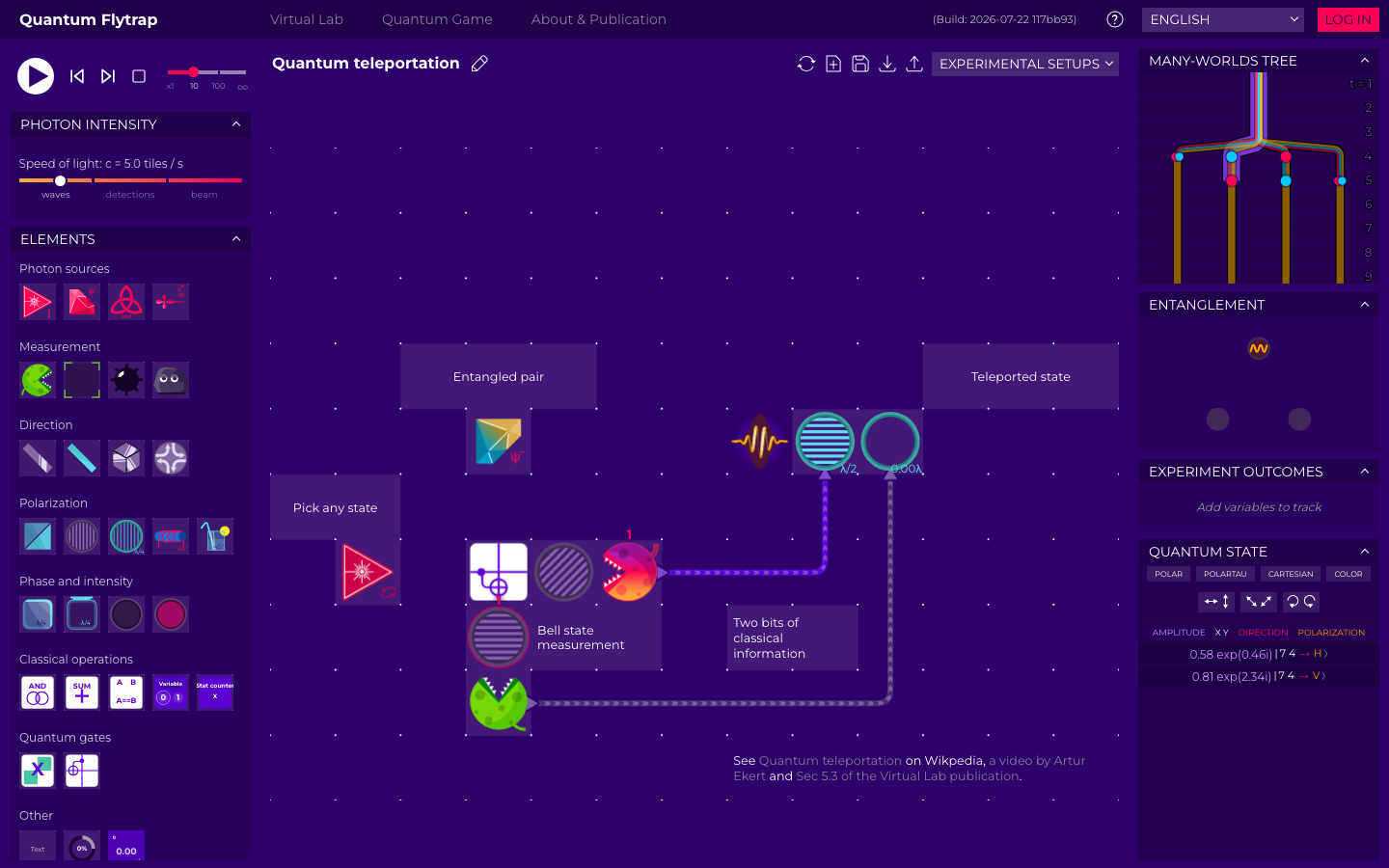
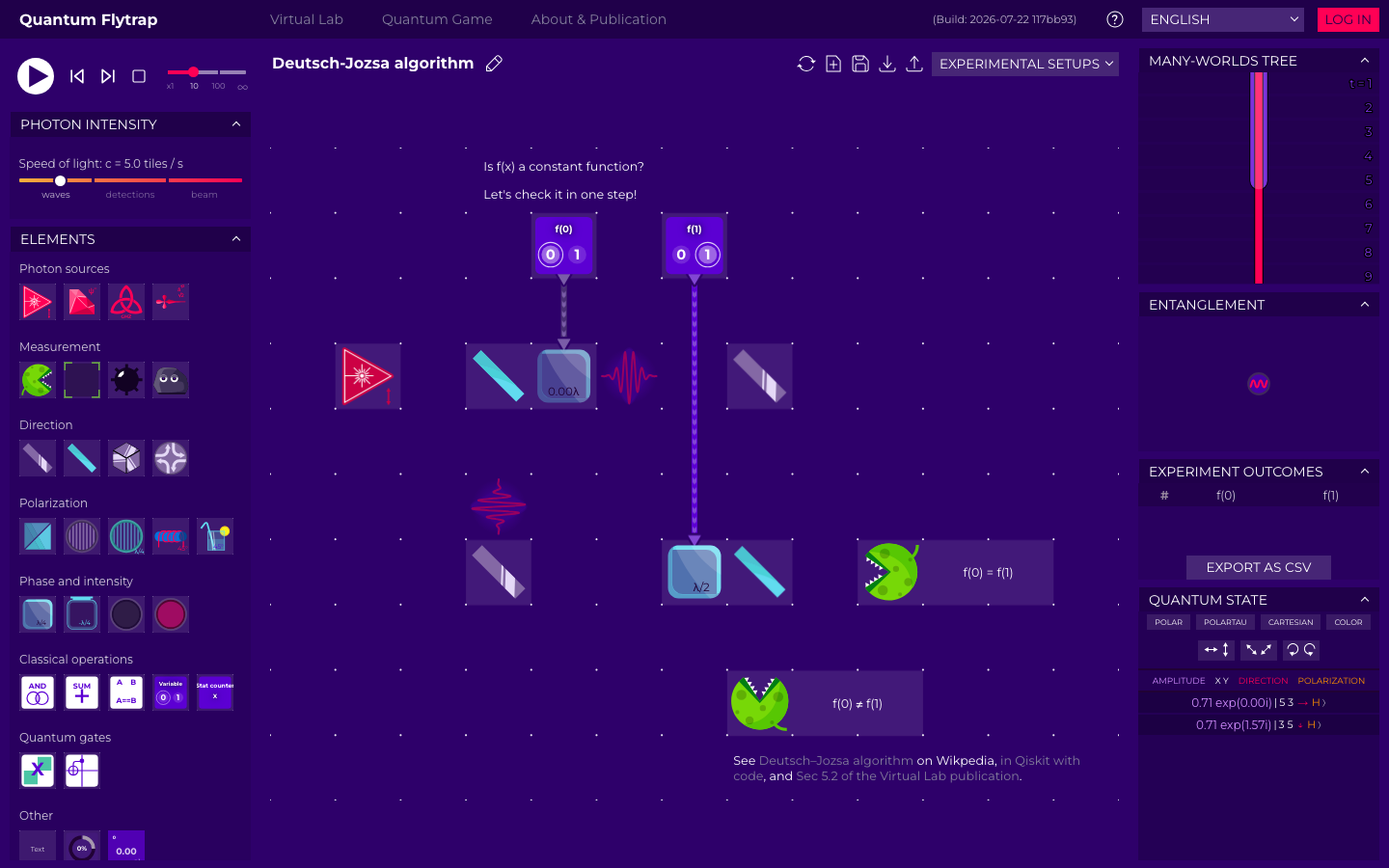
Virtual Lab is an online, no-code environment for exploring quantum phenomena. It simulates up to four entangled photons in real time, including state evolution, entanglement, measurement, the Deutsch–Jozsa algorithm, and the Ekert quantum cryptography protocol.
Its drag-and-drop optical table includes photon sources, beam splitters, gates, and detectors. It is designed for use by learners, educators, and researchers.
The project is led by Klem Jankiewicz (design), Piotr Migdał (quantum physics), and Paweł Grabarz (software development). Contributors include Agata Rakowiecka, Bijaya Dangol, Chiara Decaroli, Kamila Stępniowska, and Alicja Głuszek. Artur Ekert served as an advisor.
Virtual Lab has been used in quantum information courses at the University of Oxford and Stanford University, as well as educational events and hackathons. Earlier development was funded by the Centre for Quantum Technologies at the National University of Singapore and the Unitary Fund.
Virtual Lab is free to use in lectures and classes and will remain so. Experiment screenshots may be reused under the CC BY license in slides, textbooks, publications, and other materials.
It is available in English, Spanish, Polish, Portuguese, French, German, Ukrainian, and Chinese.
Email contact@quantumflytrap.com, or contact Piotr or Klem directly.